Abraham VanNess
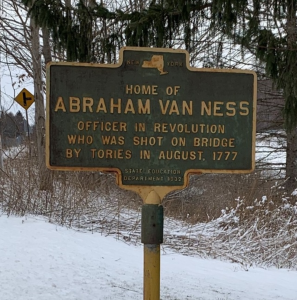
February 18, 1756 – August 12, 1777
Abraham VanNess was born in Kinderhook, NY the son of John VanNess (1725 – 1802 Lieutenant NY First Line Regiment, Continental Army) and Sara VanAllen VanNess (1729 – 1794). The VanNess family traces back to Cornelis Hendrickson VanNess who came to America in 1641 to manage the patroonship of Rensselaerwyck. The VanNess family, through maternal lineage was also related to the very powerful Schuyler family in Albany. The VanAllen family of Abraham’s Mother were the foundational patentees of Kinderhook.
In 1749 John VanNess and his wife, Sara, built a house in the area now referred to as Malden Bridge. The VanNess’s had 10 children. There are few records regarding most of the children other than date of birth. Adam was the oldest (12/26/1750). Next was Johannes (8/3/1752) Abraham was born February 18, 1756. Two years later a sister, Cattlyn came along (4/3/1758). Jacobus was next (2/15/1761); then Willem (7/5/1763). Cornelius, was born (8/5/1766) then Isaac (5/6/1768) and last was Hendryk (1/22/1770). The records I found showed dates of death for Cornilius (1832) and Isaac (1833) and, of course, Abraham (1777). While no date of death was found for Johannes, he had 5 children with his wife Nettie DeForest VanNess. (WikiTree). Suffice it to say that if all the Van Ness children survived infancy, they had a very large family to support with their farm.
The VanNess family were supporters of the Revolution and the Whigs (Patriots). The Whigs opposed the Tories (Loyalists) and the division between the two groups often led to violence. The Tories were local residents throughout the colonies and they considered the Whigs “outlaws” who should be captured, jailed or worse. The Tories often joined forces with the British soldiers deployed to the Colonies.
Originally “Whig” and “Tory” were terms of abuse introduced in England 1679 during the heated struggle over the bill to exclude James, Duke of York (afterward James II), from the succession. Whig—whatever its origin in Scottish Gaelic—was a term applied to horse thieves or cattle drovers, and later, to Scottish Presbyterians; it connoted nonconformity and rebellion and was applied to those who claimed the power of excluding the heir, James from the throne. This is different than the U.S. Whig Political party established in 1834 and disbanded in 1854.
Tory was an Irish term suggesting a papist outlaw or thief and was applied to those who supported the hereditary right of James despite his Roman Catholic faith.” (Britannica online)
In August of 1777 Abraham VanNess, a commissioned officer in the Continental Army, came home to help his family harvest their crops. The VanNess family had not seen any Tories in several days and assumed they had left the area and gone north to join General John Burgoyne’s army. General Burgoyne had amassed a significant force and was heading south through New York from Canada.
The VanNess’s and their friendly neighbors were in the fields harvesting crops when they were set upon by a band of Tories. Some sources say these Tories were part of General Burgoyne’s Army and other sources say they were headed to join General Burgoyne and found the VanNess family unprotected in the fields as they were passing through. Some of the Tories in this band knew the VanNess’s and were unfriendly neighbors and loyal to the Crown.
The Tory band attacked.
The VanNess family and their friends ran for the house and barn nearly being caught before finding refuge. The Tories attacked the doors of the house with axes bent on capturing (or worse) everyone. They smashed their way into the house and captured Abraham.
The Tories were not sure what to do with Abraham once they captured him. Some wanted to take him straight to General Burgoyne. Others in the Tory raiding party personally knew Abraham and the VanNess family and they were not in favor of this. They were concerned that should Abraham escape he could inform against them to the Continental Army.
They took Abraham outside to tie him up. He bravely fought them off and broke free running toward the barn seeking shelter. As he was crossing the bridge between house and barn, the Tories fired their muskets.
Their aim was deadly.
Abraham was struck with several musket balls. He fell on the bridge, succumbing to his several wounds.
His Father, who was in the barn and his mother who was in the house witnessed their son’s death. The Tory gang left Abraham’s body proceeded to plunder the house and then they left.
They did not get very far.
According to a neighbor, within three hours of the murder of Abraham a band of 30 patriots gathered and hunted down the band of Tories. “That very night we had three of them hanging on trees, and the next day we caught more. We did not stop to try them. Most of them were hung near Albany,” said William Van Ness quoting the neighbor.
When the funeral was held for Abraham the family needed an armed guard for fear of another Tory attack.
In October 1777, after the second battle of Saratoga, the company which the remaining Van Ness boys belonged to was present for Burgoyne’s surrender to the Americans. (Daily Gazette: History Happened Here; Abraham Van Ness Killed by Tories).
_________________
After the War Ended
It was not until 7 years later that the Revolutionary war ended September 3, 1783 with the signing of the Treaty of Paris. The newly formed Country and Government was deeply divided politically. The first constitution was referred to as the Articles of Confederation of the United States. It served as the nation’s frame of government from 1781 to 1789. Drafted to avoid the tyranny of a powerful central government, it created a loose “league of friendship” where individual states retained their sovereignty.
Structure & Powers
- One Branch: The government consisted entirely of a single-chamber legislature (the Continental Congress). There was no president to enforce laws and no federal judiciary.
- State Equality: Each state received exactly one vote in Congress, regardless of its population or size.
- Limits: Congress could declare war, make peace, sign treaties, and manage Native American affairs, but it had no power to draft soldiers, regulate interstate commerce, or levy taxes.
Because the central government had no authority to collect taxes and had little money, it struggled to pay off massive Revolutionary War debts. Congress had to rely on states to voluntarily provide funds and troops, which the states frequently ignored.
Furthermore, any amendment to the Articles required unanimous approval from all 13 states, making it impossible to fix the government’s financial and administrative failures.
Shay’s Rebellion
The breaking point occurred three years later in 1786 during Shays’ Rebellion.
A group of indebted farmers in Springfield, Massachusetts revolted against state courts over taxes and debt and demands for payment in Hard Currency which was in short supply. The currency was foreign fine metals such as the Spanish Silver dollar and gold and silver British Coins. The US did not mint their own currency until 1794. European business partners refused to extend lines of credit/loans to Massachusetts Merchants and insisted that they pay for goods with hard currency, despite the country-wide shortage of such currency. These merchants began to demand the same from their local business partners, including those operating in the market towns in the state’s interior. Many of these merchants passed on this demand to their customers who had little ability to pay. The issue was a problem in all the States.
Some of those in debt began to lose their land and other possessions when they were unable to fulfill their obligations. This led to strong resentments against tax collectors and the courts, where creditors obtained judgments against debtors, and where tax collectors obtained judgments authorizing property seizures.
The Continental Army and State militia Veterans were struggling as they received little pay for their service. The breaking point arrived when former Continental Army Captain Daniel Shays led a violent rebellion involving 1500 civilian farmers against 1200 Massachusetts militia mobilized by Governor James Bowdoin and led by former Continental General Benjamin Lincoln. The army was funded by local merchants.
The Shays, who referred to themselves as regulators, targeted the Armory in Springfield. When they arrived they were met by State Army. Warning shots were fired followed by artillery fire killing four of the Shays insurgents and wounding 20. The Shays faltered and scattered into the hillside.
The federal government was powerless to stop the insurrection highlighting the urgent need for a stronger national framework. Shay’s’ rebellion nearly toppled the newly formed United States of America under the Articles of Confederation. The rebellion set the stage for General George Washington’s return to political life.
This led to the Constitutional Convention (Philadelphia Convention) in 1787 when General Washington was elected to be our first Preside over the convention after which the Articles of Confederation were scrapped and replaced by the (then unamended) United States Constitution. George Washington became the first President of the United States of America on February 4, 1789.
While Shays’ Rebellion nearly toppled the new nation, it also helped the new Congress to formulate a stronger central government.
Political Parties
President Washington was against Political Parties. Greatly concerned about the growing partisanship within the government and the detrimental impact political parties could have on the fragile unity of the nation, Washington struggled throughout his eight-year presidency to hold rival factions together. He was, and remains, the only U.S. president never to be formally affiliated with a political party.
Political Parties emerged shortly after the war, each with their own agenda and bitterly opposed to each other, leading to violence.
- Federalists: Advocated for a strong central government and supported the Constitution.
- Anti-Federalists: Opposed the Constitution, fearing it gave too much power to the federal government.
- Democratic-Republicans: Emerged later, promoting states’ rights and agrarian interests in 1783 against Federalist policies.
Differences between rival parties led to Street brawls and rebellions. During the 1788 debates over whether to approve the Constitution, public celebrations and marches often turned into physical fights. For example, a July 1788 Federalist march in Albany, New York, was blocked by Anti-Federalists, leading to a massive street battle with swords, clubs, and stones.
Another rebellion by Federalists was the Whiskey Rebellion organized against the Federal Whiskey tax (the rebellion was put down by President Washington leading troops).
The Democratic-Republicans also rebelled in 1799 known as Fries Rebellion against the new Federal Property Taxes where tax collectors were attacked and prisoners freed until Federal troops ended the uprising.
Partisanship was fueled by Newspapers that would go to great lengths to support one party by disparaging other parties with untruths.
There were the Riots in 1812 following the declaration of war (War of 1812) where a Mob supporting the war attacked the antiwar Federalist newspaper (Federal Republican) office in Baltimore. The printing press and building were destroyed and the publisher, Alexander Hanson, was forced to flee.
Hanson and his pro-British friends secretly returned and barricaded themselves in a brick house and tried to re-establish the Newspaper. The occupants were put under siege and in a violent stand off left a protestor dead (shot). Local authorities negotiated a truce and moved Hanson and his friends to the local jail for their safety but the mob stormed the jail and dragged all the men out. They were badly beaten. One man died and others were left disfigured.
As we consider this 250 year birthday of the United States of America with the signing of the Declaration of Independence it is important the remember that divisions among the citizens and within the government almost derailed the new country. The Revolutionary war did not end until 7 years later. While the war with England ended, the often passionate divisions within the country remained. Over the years from that day to this, some of these divisions were promoted by political leaders and even sitting Presidents. The greatest divisions occurred through the 1860’s and were resolved by Civil war after which the country was again unified.
Through all of the United States history the one take away is that we are all Americans. When the chips are down we pull together as a country and as citizens of a Democratic Republic.
Happy 250th Birthday to the United States of America. Happy Birthday to us.
Nancy Stock, Malden Bridge, NY